
Standing Practice
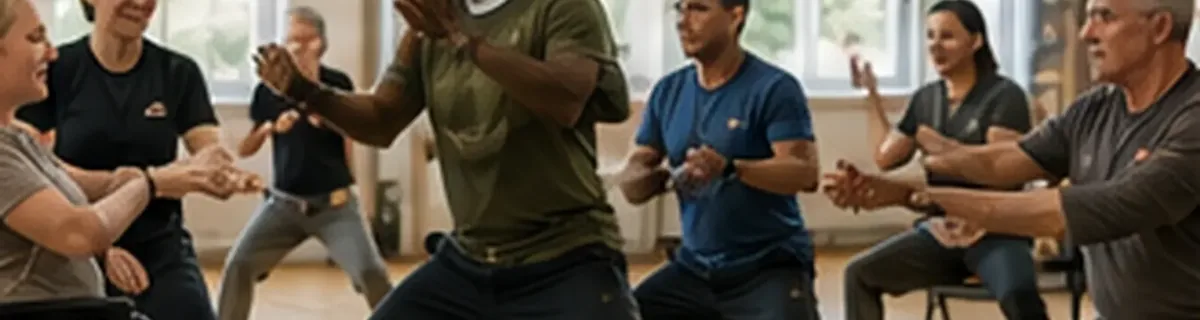
Standing Practice
Quick Answer
What is standing practice?
Standing practice uses safe standing or supported standing, small movements, breathing, visualization, and planned rest without treating standing as more valuable than other positions.
Standing deserves its own visible category because many people with MS can practice while standing, with or without support.
Standing Practice May Include
- Natural posture and weight awareness.
- Supported standing near a stable surface when appropriate.
- Small shifts rather than large steps.
- Gentle hand positions or short technique sequences.
- Breathing paired with posture.
- Visualization before or instead of physical movement.
- Planned rest before fatigue becomes overwhelming.
Standing is not a requirement and should not be treated as a higher-value form of practice. It is one available position among several.
Accessible Future Class3 min
Imagine a class where adaptations are normal.
Practice
Picture standing, seated, wheelchair-based, and other participants receiving options without being singled out. Notice clear cues and respectful pacing.
Adapted Closing Gesture2 min
Visualize a respectful way to close practice.
Practice
Picture a bow, nod, hand position, breath, or other accessible closing gesture. Choose the version that fits your position and tradition.
Adapted Success5 min
Imagine completing an adapted version rather than a traditional version.
Practice
Choose one practice that usually feels difficult. Picture a smaller, seated, supported, or mental version that still teaches the same principle.
Arrival Breath2 min
Use three natural breaths to arrive in the present moment.
Practice
Notice where the body is supported. Breathe in naturally. Breathe out without forcing. Repeat for three comfortable breaths, noticing one detail in the room after each exhale.
Breath and Posture3 min
Connect breathing with an easy posture reset.
Practice
On an inhale, imagine or allow the spine to lengthen slightly. On the exhale, soften unnecessary effort. Repeat three times without forcing position.
Breath With Appreciation4 min
Connect one breath with something supportive.
Practice
Choose one person, object, place, or ability that supports you today. Breathe naturally for three breaths while holding that idea without forcing a positive mood.
Breath-Led Sequence3 min
Pair an imagined movement with ordinary breathing.
Practice
Imagine preparing on an inhale and beginning a simple movement on an easy exhale. Do not hold the breath. Repeat three times.
Closing Breath1 min
End practice with a deliberate, ordinary breath.
Practice
Notice what position you are in. Take one comfortable breath and acknowledge that the practice is complete. No evaluation is required.
Confident Entry4 min
Visualize beginning practice without needing to prove anything.
Practice
Picture arriving, choosing an appropriate position, and starting with one manageable action. Notice calm preparation rather than performance.
Create a Calm Practice Space2 min
Imagine a quiet, accessible place for practice.
Practice
Picture lighting, space, support, temperature, and sound that would help you practice. Notice one detail at a time for two minutes.
Easy Longer Exhale2 min
Experiment with an unforced exhale that is slightly longer than the inhale.
Practice
Breathe in comfortably. Let the exhale continue a little longer only if it feels natural. Repeat three times. Return to ordinary breathing immediately if uncomfortable.
Energy Check-In1 min
Use breathing to notice current energy without judgment.
Practice
For three breaths, notice whether energy feels low, moderate, changing, or hard to describe. Choose the next practice based on that information rather than expectation.
Frequently Asked Questions
Does standing practice require unsupported balance?
No. Standing practice may use appropriate support and small, controlled movements.
Is standing practice better than seated practice?
No. They are different access options. The meaningful practice is the one that fits the person safely today.
Can I switch from standing to seated practice during a session?
Yes. Adapting position is part of practice, not a failure.