
Adaptive Martial Arts Training

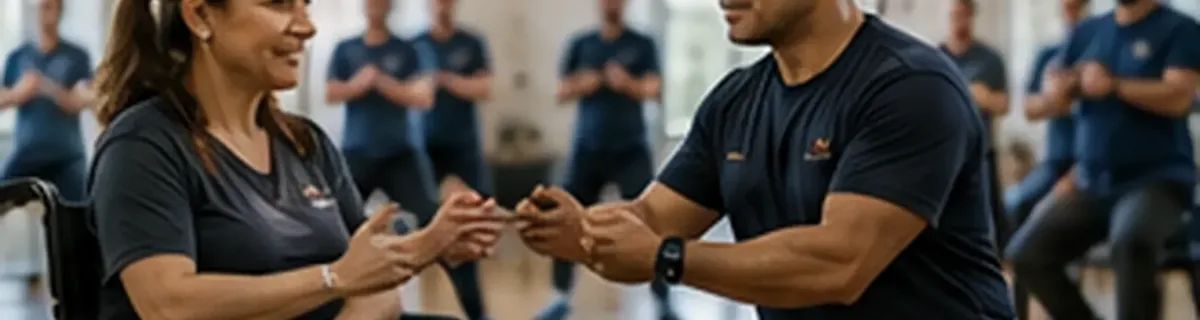
Photorealistic adaptive martial arts training image showing controlled movement and MS-aware practice

Adaptive Martial Arts Training

Seated, supported, slowed, shortened, and visualized martial arts practice for people living with multiple sclerosis.

Adaptive Martial Arts Training

Adaptive martial arts training changes the practice to fit the person. It does not force the person to fit the technique. In many traditional martial arts spaces, students may be expected to stand, step, pivot, kick, spar, or move quickly. For someone living with MS, those expectations may be unsafe or unrealistic. MA4MS reframes the practice around control, breath, awareness, adaptation, and safety.

A martial arts movement can be modified in several ways. It can be done seated. It can be performed with support from a wall, chair, cane, walker, training partner, or caregiver. It can be slowed down. It can be shortened. It can be practiced only with the hands. It can be broken into small pieces. It can also be rehearsed mentally. The principle matters more than the appearance of the technique.

The MA4MS approach is supported by careful reading of external resources, not by exaggerated promises. The National MS Society describes exercise and physical activity as playing a crucial role in MS management. Mayo Clinic also discusses exercise in relation to strength, balance, muscle tone, and coordination. Those ideas do not mean every person with MS should train the same way. They mean movement deserves respect, adaptation, medical awareness, and practical judgment.

Training examples include seated blocks, slow punches, posture alignment, breath-led hand forms, eye focus drills, relaxed shoulder positioning, supported weight shifts, and mental kata. None of these need to be aggressive. None need to be competitive. A person can practice martial arts principles without sparring, impact, or exhaustion. For many people with MS, removing pressure may make the practice more sustainable.

Safety is central. Heat sensitivity, fatigue, fall risk, weakness, spasticity, pain, dizziness, and sensory changes can all affect practice. That means training should begin with a check-in. How much energy is available? Is support needed? Is the room cool enough? Is the floor safe? Is there a reason to practice seated today? Is visualization the better choice?

Adaptive martial arts also has emotional value. Many people do not only lose movement when illness progresses; they lose activities that once shaped identity. A modified movement can become a bridge between who a person was and who they are becoming. MA4MS respects that connection.

Helpful Internal Paths

MS & Movement

Learn how pacing, fatigue awareness, breathing, and body awareness shape adaptive movement.

Adaptive Training

Explore seated, supported, slowed, and visualized martial arts practice.

Visualization

Use mental rehearsal to stay connected to movement when physical practice is limited.

Resources

Review external references and educational resources supporting the MA4MS approach.

Relevant Visual Examples

These photorealistic-style visual examples are included to help visitors understand the MA4MS themes of adaptive movement, seated martial arts practice, visualization, and safe training. They are educational examples, not medical instruction.

Photorealistic example of adaptive movement and seated martial arts practice for people living with multiple sclerosis
Adaptive movement can include seated practice, posture awareness, breathing, and controlled upper-body motion.
Photorealistic example of mental imagery and visualization practice for martial arts and multiple sclerosis
Visualization can support mental rehearsal of movement, timing, posture, breath, and martial arts forms.
Photorealistic example of adaptive martial arts training using controlled movement and MS-aware pacing
Adaptive training may include slower movement, shorter routines, support, rest, and symptom-aware pacing.

About the Author

Author David Ellinger of MA4MS, a martial artist and technologist living with multiple sclerosis

Author David Ellinger created MA4MS from lived experience as a martial artist, technologist, web developer, and person living with multiple sclerosis. His approach combines adaptive practice, mental imagery, technical creativity, and respect for the physical realities of MS.

MA4MS is powered by The Edge of Eternity Networks, supporting the technical foundation, website presence, accessibility direction, and long-term educational growth of this project.

Research References and External Resources

The external links below are provided as dofollow educational resources. They support the MA4MS approach to MS-aware movement, balance, motor imagery, rehabilitation, fatigue awareness, and adaptive practice.

Safety Reminder

Educational content only. MA4MS does not provide medical advice, diagnosis, treatment, physical therapy, or emergency guidance. Anyone living with multiple sclerosis should speak with a qualified healthcare professional before starting or changing exercise, martial arts practice, breathing work, visualization routines, or rehabilitation-related activity.